
What Is Our Goal?
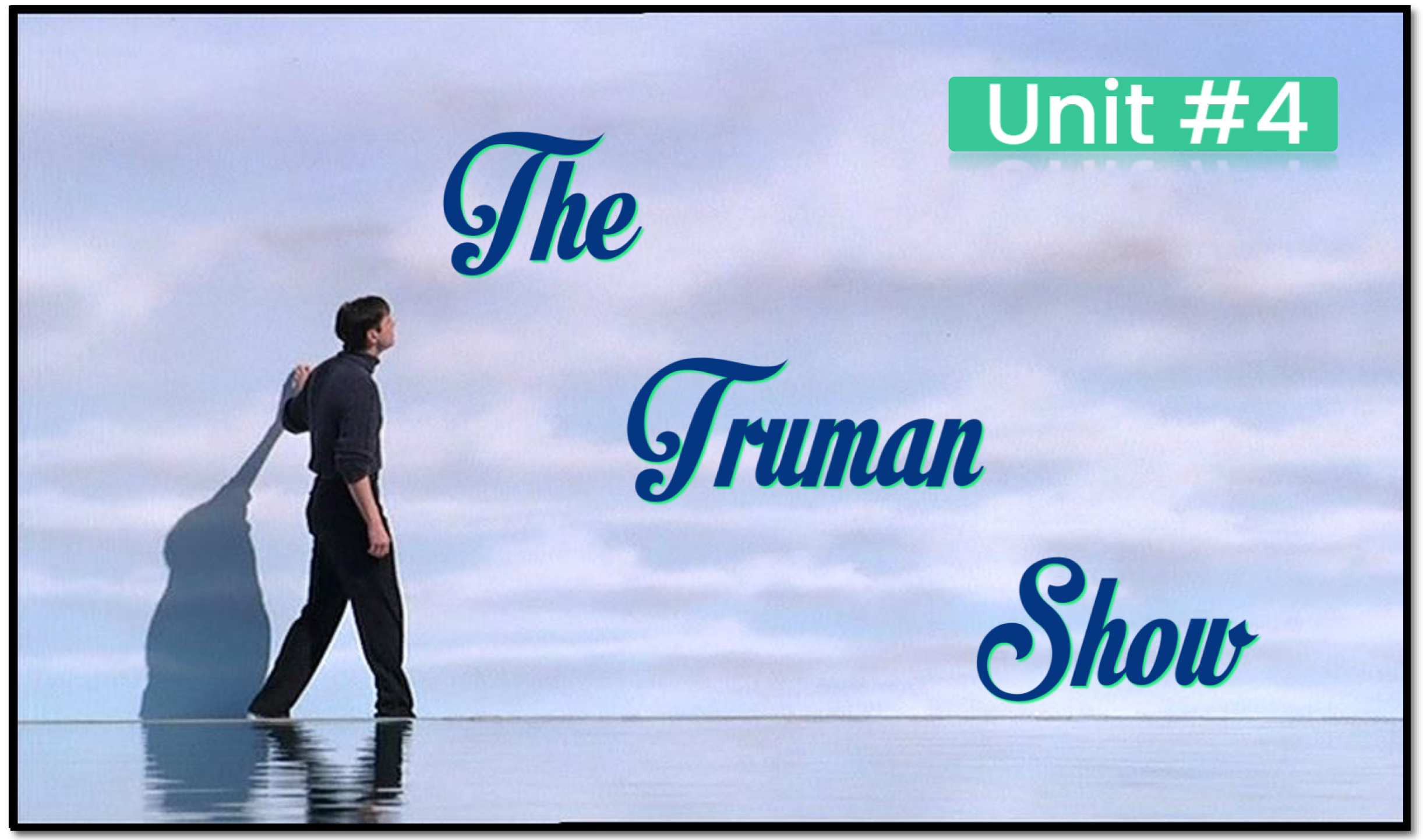
How does media influence us? How do advertisements and televised media affect our concepts of identity and community? How do the stereotypes and branding of media shape our relationships with each other? In our fourth unit this year, we will delve into these questions as analyze the film, The Truman Show, by directed by Peter Weir. By the end of this unit, each student will thoroughly analyze shots from our film, complete SSCASI notes and scene analysis posters, and complete a final project with group presentation or a solo piece of analysis writing that will be published on their learner’s portfolio.

What Will We Be Doing?
Ready? Set! Action! In our fourth unit this year, we’ll analyze the film, The Truman Show, which is a highly acclaimed film directed by Peter Weir that was released in 1998. Our movie stars Jim Carrey who plays Truman Burbank. Truman is adopted at birth by a giant media corporation that, unbeknownst to him, films his life through thousands of hidden cameras and streams it as the world’s most popular reality TV show. As strange occurrences begin to pique Truman’s interest, he begins to question whether the people around him are all conspiring to keep him trapped on the island community of Sea Haven. Truman’s quest to escape and discover the real world becomes emblematic of our own desire to seek out an authentic life, free from the trappings of media, beyond the artificial cravings provoked by ads, a highly regimented corporate work place, and a community filled with individuals who are more concerned with TV ratings and attention than true connection and happiness.
This unit will constitute a non-literary body of work, which students may use for the individual oral exams in February. In order to prepare for those exams, students will learn over a dozen film studies terms and practice close reading and annotating shots and our script in class. At the end of our unit, students will choose to present a 15 minute Google Slides speech about a line of inquiry and scenes they choose to analyze, or they will complete a multi-paragraph piece of analysis writing on their own (two to three pages). All presentations and analysis grades will count as a proof and will include written-teacher feedback, a scored rubric, and time in class for revisions.
How Will I Be Graded?
Every day in class, we will be practicing reading, writing, and speaking. Students will receive constructive feedback and daily in-class assignments, including their annotations of scene from our film and SSCASI notes. All annotations will be included in the printed copy of the script in each student’s packet (see the link below). Students will also receive multiple prep scores for presenting poster projects and group presentations. Students should have three to five shots closely analyzed and annotated in their packets by the second week of our unit.
Additionally, students will earn a “proof” grade for one of two final projects: multi-paragraph argumentative analysis ; or, a group Google Slides presentation. Prior to receiving a final grade on their projects, students will have peers leave constructive criticism and will be given the opportunity to boost their grade after receiving initial feedback and a grade from Mr. Edwards on Google Classroom. Once students revise their writing and deliver their presentations, their grades will be final. All projects will be on a 10 point scale using the IB rubrics, with 10 signifying “mastery,” or an “A+,” and a 4 signifying “proficient” (B).
There will be time in class to complete our daily reading, annotations, and our final projects. That being said, students may need to revise, review, and complete their work at home. Below, I’ve included several examples of the assignments students will be completing during this unit.

With our new film terms, you’ll analyze shots from our movie and lead small group discussions.


Grade Distribution
Prep:
Reading and Writing Assignments: (20%) Complete thoughtful and detailed SSCASI notes for three to five shots and group poster presentations, including a thoughtful analysis with a point, illustration and explanation.
Proofs
Google Slides Presentation: (80%) You will present a Google Slides presentation in class with a group of two to three of your peers on Friday, January 26th. During your presentation, your team will state a line of inquiry, a strongly worded thesis, and analysis of three to five shots that connect to your LOI and support your thesis.
Analysis Writing: (80%) In place of the presentation, if you choose to write two three pages of argumentative analysis writing, then you will submit your final revisions by Friday, January 26th. All analysis writing should include a line of inquiry, thesis statement, at least two PIEIES paragraphs, and a short intro and conclusion. Final grades will be assessed using the analysis and knowledge strands of the IO rubric.
Classroom Resources
1. Unit Materials: Students will primarily use a color-printed and spiral bound packet, which is included below. Given the need to reference materials throughout the year, it is imperative that all students keep their packet work in good condition. Below, I’ve included a PDF copy of our packet and teacher-model of our Google Slides presentation
2. Weekly PowerPoints: Weekly PowerPoint slides will be posted on Google Classroom. However, if you’d like to learn more about our class -or preview the work students will engage in, then please feel free to click the links below. Aside from the first two weeks of lessons, this page will not include the later half of our unit. Contact Mr. E. directly for more info.