What Is Our Goal?
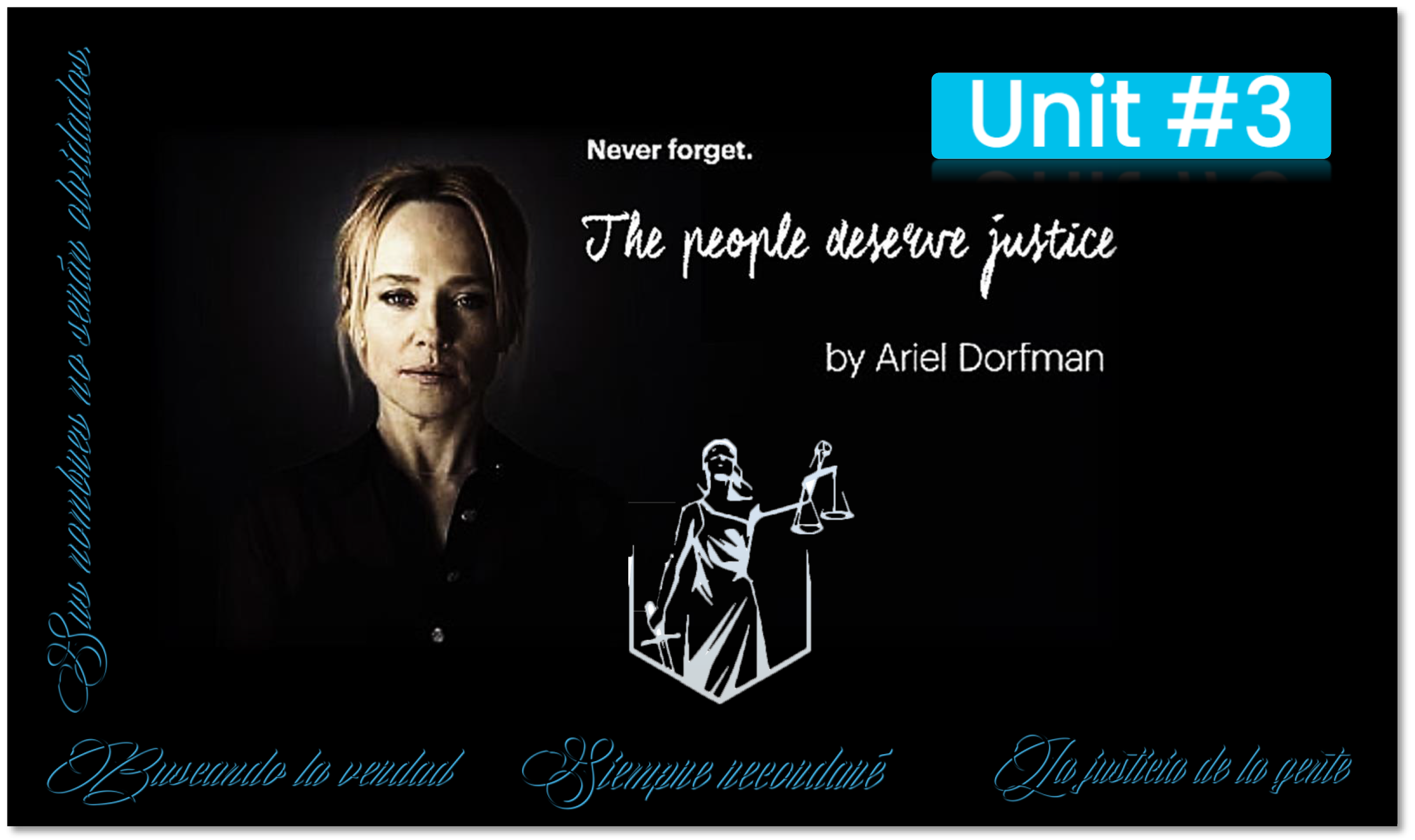
How does art reflect the time and place when it was written? How does is art shaped by history? Can art change our understanding of history? During our third unit, we will explore these questions as we analyze the play, Death and the Maiden, by Ariel Dorfman. At the end of this unit, each student will thoroughly analyze the scenes from our play, complete SSCASI notes and reading response questions, participate in a graded discussion, write a practice paper two essay, and complete a reflection on their learner’s portfolio.

What Will We Be Doing?
In our third unit this year, we’ll close read and analyze Death and the Maiden by Ariel Dorfman. Dorfman is a Chilean playwright and expatriate who sought refuge from his home country after the dictator, Augosto Pinochet, overthrew the democratically elected president, Salvador Allende. In Death and the Maiden, Dorfman stages a harrowing mystery that begins when a stranger knocks on the door of a remote cabin on the coast and interrupts a couple’s vacation. As the stranger begins to ask pointed questions about the couple’s past, events quickly spiral out of control and a deadly conflict ensues.
This unit will constitute a literary unit, which students may use for the individual oral exams in February or their paper two exams in April. In order to prepare for those exams, students will learn over a dozen literary terms and practice close reading and annotating texts in class. At the end of our unit, students will have participated in a graded discussion, called Philosophical Chairs, or a Backchannel Chat about various themes from our novel. Additionally, we will use several class periods to write a paper two comparative analysis essay, which will include our play and one other literary text that students choose. All essays will be graded as a proof and will include written-teacher feedback, a scored rubric, and time in class for revisions.
How Will I Be Graded?
Every day in class, we will be practicing reading, writing, and speaking. Students will receive constructive feedback and daily in-class assignments, including their annotations of scene from our play and SSCASI notes. All annotations will be included in the printed copy of the play in each student’s packet (see the link below). Students will also receive multiple prep scores for answering reading response questions, which are enumerated in the back of their packets. Students should write one to two pages weekly for their reading response questions and turn them into our homework bin in class.
Additionally, students will earn a “proof” grade for two assessments: a graded classroom discussion (click here to learn more); and a comparative analysis essay (also known as a paper two exam). Prior to receiving a final grade on their essays, students will have peers leave constructive criticism and will be given the opportunity to boost their grade after receiving initial feedback and a grade from Mr. Edwards on Google Classroom. Once students revise their essays, their grades will be final. All essays will be on a 10 point scale using the IB rubrics, with 10 signifying “mastery,” or an “A+,” and a 4 signifying “proficient” (B).
There will be time in class to complete our daily reading, annotations, and our comparative analysis essay. That being said, students may need to revise, review, and complete their work at home. Below, I’ve included several examples of the assignments students will be completing during this unit.

With our new lit terms, you’ll analyze themes from our play and lead small group discussions.


Grade Distribution
Prep:
Reading and Writing Assignments: (20%) Complete thoughtful and detailed SSCASI notes and three reading response assignments, including a thoughtful analysis with a point, illustration and explanation.
Proofs
Philosophical Chairs or Backchannel Chat: (30%) Our graded discussion will take place Friday, January 5th. During our discussion, you’ll choose one of several options for participating, including: prepping an outline and participating in five rounds of Philosophical Chairs; or, signing up for our Backchannel Chat.
Comparative Analysis Essay: (50%) All final revisions for our paper two essays will be due Friday, January 19th. This essay will be modeled off of the final assessment for our IB college exams, which entails writing a comparative analysis in response to one of four prompts you choose. After reviewing the paper two expectations, rubric, and evaluating student examples, you’ll have an hour and a half to hand write an essay in class. Next, we’ll use some writer’s workshops, including peer revisions, mini-lessons, and checklists to type up and revise final drafts of your essays.
Classroom Resources
1. Unit Materials: Students will primarily use a color-printed and spiral bound packet, which is included below. Given the need to reference materials throughout the year, it is imperative that all students keep their packet work in good condition. Below, I’ve included a PDF copy of our packet and our paper two essay.
2. Weekly PowerPoints: Weekly PowerPoint slides will be posted on Google Classroom. However, if you’d like to learn more about our class -or preview the work students will engage in, then please feel free to click the links below. Aside from the first two weeks of lessons, this page will not include the later half of our unit. Contact Mr. E. directly for more info.